What Does "Sustainable" Actually Mean?
- Filed
- 3 November 2026
- Location
- London, United Kingdom
"Sustainable" is on almost every product label now. It's on chairs, flooring, paint, packaging, whole collections. It sits in briefs, in pitch decks, in the sustainability section of every annual report.
But what does it actually mean?
The more often a word is used, the less often we stop to question what it means. So we want to go back to the beginning: where the word comes from, who defined it, and how something with decades of careful thinking behind it became a label we attach to almost anything.
Where the word comes from
At its root, "sustain" is a physical word. It comes from the Latin sustinere: sub, "from below", and tenere, "to hold". To sustain something is to hold it up from underneath, to bear its weight so it doesn't fall.
For most of its life in English, "sustainable" meant something modest. In the 1600s it meant bearable. By the 1800s it meant defensible, something an argument could stand on. Only in the 1960s did it take on the meaning we know today: capable of being continued or maintained over time.
We like that origin. It reminds us that sustainability isn't a product feature or a finish. It's about what holds things up, and for how long.
1987: the definition everyone quotes
In 1983, the United Nations established the World Commission on Environment and Development, chaired by Gro Harlem Brundtland, former prime minister of Norway. The Commission published its report, Our Common Future, in 1987. It is now usually called the Brundtland Report.
It gave sustainable development the definition most people still quote:
"Sustainable development is development that meets the needs of the present without compromising the ability of future generations to meet their own needs."
It's a definition that goes beyond protecting a single aspect. It talks about needs and about time. It asks us to consider the people living now alongside those who will live after us.
That's a question about how we live and make decisions, not simply what we produce.

Three dimensions, not one
Over the following years, sustainability came to be understood through three connected dimensions: environmental, social and economic.
The three-pillar model doesn't have one clearly identifiable point of origin. It developed gradually through discussions about how environmental protection, social well-being and economic development relate to one another.
Together, these dimensions offer a broader way of thinking about what it means to sustain something.
Environmental sustainability considers how we use natural resources, affect ecosystems and manage the impact of our activities.
Social sustainability considers people's well-being, equality, health, working conditions and access to opportunities.
Economic sustainability asks whether activities and systems can remain viable over time, without undermining the resources and conditions they depend on.
None of these dimensions exists entirely on its own. Looking at only one gives us an incomplete picture.
2015: seventeen shared goals
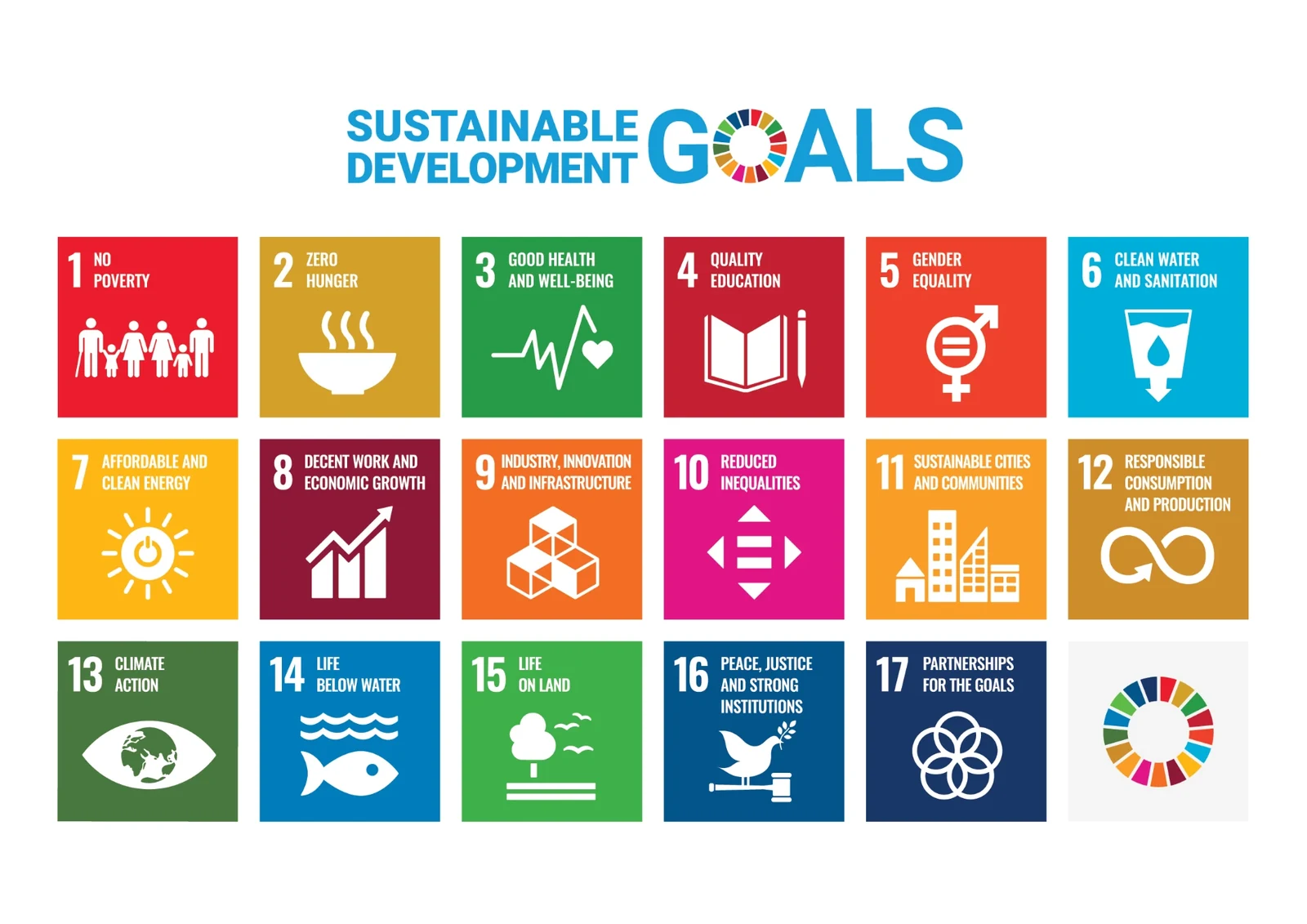
In September 2015, all 193 UN member states adopted Transforming our World: The 2030 Agenda for Sustainable Development.
At its centre are 17 Sustainable Development Goals, covering many aspects of life, from poverty and health to education, equality, clean water, energy, cities and climate.
The goals brought environmental, social and economic ambitions into one shared global framework. They also made something clear: sustainability isn't a single issue that can be solved in isolation. It involves how societies develop, how resources are distributed and how decisions affect people across generations.

How the word lost its weight
So the word carries decades of careful thinking: a definition about needs and time, three connected dimensions and seventeen global goals.
Yet in recent years, the word has been attached to almost anything. A chair made from recycled plastic. A bamboo toothbrush. A new "green" collection. Often it seems to mean little more than "made from a better material".
This is right in one respect. Material is the easiest part to see, photograph and put on a label. Repairability, carbon in transport or what happens in fifteen years are much harder to show. So the visible part ends up standing in for the whole.
Sometimes, even well-intentioned material choices become shortcuts for communicating sustainability. At their worst, these shortcuts turn into greenwashing: claims that sound sustainable but don't hold up when you ask the next question. More often, they're simply incomplete. Something might be a better choice in one respect, but that doesn't tell us the whole story.

A familiar word, an unfamiliar question
Sustainability has become a familiar word. We see it, hear it and use it every day. But familiarity doesn't necessarily mean understanding.
Perhaps it's worth occasionally going back to the beginning and asking what we actually mean when we use it.
When you hear "sustainable", what's the first thing that comes to mind?
Sources
Etymology of "sustainable" - Online Etymology Dictionary: https://www.etymonline.com/word/sustainable
1987: Brundtland Report - Swiss Federal Office for Spatial Development: https://www.are.admin.ch/en/1987-brundtland-report
Purvis, Mao & Robinson (2019), "Three pillars of sustainability: in search of conceptual origins", Sustainability Science: https://eprints.whiterose.ac.uk/id/eprint/136715
The 2030 Agenda for Sustainable Development - United Nations: https://sdgs.un.org/2030agenda